
Question 21
Refer to the exhibit.
R1# show ip route
Codes: L - local, C - connected, S - static, R - RIP, O - OSPF, B - BGP
       D - EIGRP, EX - EIGRP external, IA - OSPF inter area
       N1 - OSPF NSSA external type 1, N2 - OSPF NSSA external type 2
       E1 - OSPF external type 1, E2 - OSPF external type 2
       i - IS-IS, su - IS-IS summary, L1 - IS-IS level-1, L2 - IS-IS level-2
       ia - IS-IS inter area, * - candidate default, U - per-user static route
       o - ODR, P - periodic downloaded static route

Gateway of last resort is not set

  192.168.20.64/27 is variably subnetted, 1 subnet, 1 mask
O    192.168.20.64/27 [110/20] via 10.0.0.3, 00:00:01, Gig0/1
D    192.168.20.64/27 [90/25] via 10.0.0.4, 00:00:01, Gig0/2

  192.168.20.96/28 is variably subnetted, 1 subnet, 1 mask
O    192.168.20.96/28 [110/30] via 10.0.0.3, 00:00:01, Gig0/1
D    192.168.20.96/28 [90/30] via 10.0.0.4, 00:00:01, Gig0/2

  192.168.20.104/29 is variably subnetted, 1 subnet, 1 mask
O    192.168.20.104/29 [110/40] via 10.0.0.5, 00:00:01, Gig0/1
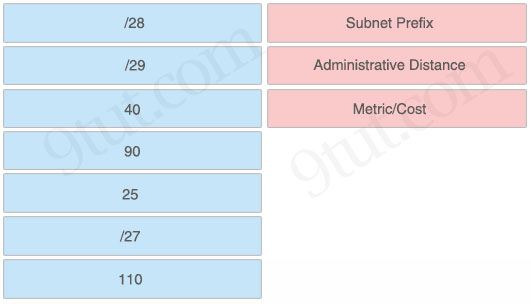
D 192.168.20.104/29 [90/40] via 10.0.0.6, 00:00:01, Gig0/2A packet is destined for 192.168.20.108. Drag and drop the parameters of the destination route from the left onto the routing table components they represent on the right. Not all parameters are used.
Answer:
/29: Subnet Prefix
90: Administrative Distance
40: Metric/Cost
Explanation
For destination 192.168.20.108, the local router will choose the last entry (D 192.168.20.104/29 [90/40] via 10.0.0.6, 00:00:01, Gig0/2) to match. Therefore /29 is the subnet prefix; 90 is the AD while 40 is the metric/cost of this route.