
Question 1
Which two QoS tools are used to guarantee minimum bandwidth to certain traffic? (Choose two)
A. FIFO
B. CBWFQ
C. LLC
D. WFQ
E. RSVP
Answer: B D
해설>
B. CBWFQ (Class-Based Weighted Fair Queuing)
- 관리자가 트래픽을 Class로 분류하고, 각 클래스에 최소 대역폭을 직접 숫자로 지정할 수 있는 QoS 기술입니다.
- 예를 들어 “업무용 ERP 트래픽에는 전체 대역폭의 30%를 할당한다”라고 설정하면 망이 아무리 붐벼도 해당 트래픽은 전체 대역폭의 30%를 보장받게 됩니다.
D. WFQ (Weighted Fair Queuing)
- 트래픽 Flow 별로 우선순위를 자동으로 계산하여 대역폭을 공정하게(Fair) 나누어 주는 방식입니다.
- 낮은 대역폭을 사용하는 트래픽(예: VoIP)에 우선순위를 높게 주어, 결과적으로 모든 flow가 필요한 대역폭을 확보하도록 하여, 최소한의 대역폭을 공평하게 나누어 가질수 있도록 보장합니다.
Question 2
Drag and drop the SNMP manager and agent identifier commands from the left onto the functions on the right.
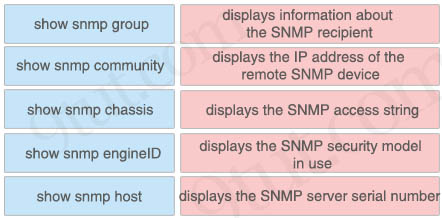
Answer:
- show snmp group: displays the SNMP security model in use (현재 사용중인 SNMP 보안 모델 정보를 표시)
- show snmp community: displays the SNMP access string (SNMP 커뮤니티 스트링/액세스 문자열 표시)
- show snmp chassis: displays the SNMP server serial number (SNMP 서버의 샤시 시리얼 번호 표시)
- show snmp engineID: displays the IP address of the remote SNMP device (로컬/원격 SNMP 장치의 고유 식별자인 EngineID 및 관련 정보 표시)
- show snmp host: displays information about the SNMP recipient (SNMP 트랩이나 알림을 받는 수신처/호스트 정보 표시)
💡 각 명령어 핵심 포인트
- show snmp group: SNMPv3에서 보안 모델(User-based Security Model) 및 접근 권한 그룹을 확인할 때 필수적인 명령어입니다.
- show snmp community: 주로 SNMPv1, v2c에서 사용하는 암호와 같은 ‘Community String’을 보여줍니다.
- show snmp chassis: 장비의 물리적 식별 번호(Serial)를 SNMP를 통해 확인할 때 사용합니다.
- show snmp engineID: SNMPv3 통신에서 개별 장비를 고유하게 식별하기 위한 ID를 출력합니다.
- show snmp host: 설정된 트랩 서버(Trap Receiver)의 IP 주소와 상태를 확인할 수 있습니다.
Question 3
Which type of security program is violated when a group of employees enters a building using the ID badge of only one person?
A. intrusion detection
B. user awareness
C. physical access control
D. network authorization
Answer: C
Question 4
A network administrator needs to aggregate 4 ports into a single logical link which must negotiate layer 2 connectivity to ports on another switch. What must be configured when using active mode on both sides of the connection?
A. 802.1q trunks
B. Cisco vPC
C. LLDP
D. LACP
Answer: D
Question 5
In which situation is private IPv4 addressing appropriate for a new subnet on the network of an organization?
A. There is limited unique address space, and traffic on the new subnet will stay local within the organization.
B. The network has multiple endpoint listeners, and it is desired to limit the number of broadcasts.
C. Traffic on the subnet must traverse a site-to-site VPN to an outside organization.
D. The ISP requires the new subnet to be advertised to the internet for web services.
Answer: A
Question 6
Aside from discarding, which two states does the switch port transition through while using RSTP (802.1w)? (Choose two)
A. listening
B. blocking
C. forwarding
D. learning
E. speaking
Answer: C D
RSTP(802.1w)의 포트 상태
RSTP는 네트워크의 수렴속도(Convergence)를 빠르게 하기 위해서, 기존 STP의 복잡한 5개 상태를 3개 상태로 단순화하였습니다.
- Discarding (폐기): 데이터를 전달하지 않으며, MAC 주소를 학습하지도 않습니다. (기존 STP의 Blocking, Listening, Disabled가 합쳐진 상태입니다)
- Learning (학습): 데이터를 전달하지는 않지만, MAC 주소 테이블은 생성(학습)하기 시작합니다.
- Forwarding (전송): 데이터를 정상적으로 전달하고 MAC 주소도 계속 학습합니다.
STP(802.1D) vs RSTP(802.1w) 비교
두 프로토콜의 상태 변화를 비교하면 정답이 왜 C, D인지 더 명확해집니다.
| STP (802.1D) 상태 | RSTP (802.1w) 상태 | 데이터 전송 여부 | MAC 학습 여부 |
| Disabled | Discarding | No | No |
| Blocking | Discarding | No | No |
| Listening | Discarding | No | No |
| Learning | Learning | No | Yes |
| Forwarding | Forwarding | Yes | Yes |
Question 7
What is a role of wireless controllers in an enterprise network?
A. serve as the first line of defense in an enterprise network
B. support standalone or controller-based architectures
C. centralize the management of access points in an enterprise network
D. provide secure user logins to devices on the network
Answer: C
Question 8
How do servers connect to the network in a virtual environment?
A. wireless to an access point that is physically connected to the network
B. a cable connected to a physical switch on the network
C. a virtual switch that links to an access point that is physically connected to the network
D. a software switch on a hypervisor that is physically connected to the network
Answer: D
Question 9
Which CRUD operation corresponds to the HTTP GET method?
A. read
B. update
C. create
D. delete
Answer: A
1. CRUD와 HTTP Method 매핑
CRUD는 대부분의 소프트웨어가 가지는 기본적인 데이터 처리 기능인 C(reate), R(ead), U(pdate), D(elete)의 약자입니다. 웹에서는 이를 HTTP Method와 연결하여 사용합니다.
| CRUD 작업 | HTTP Method | 설명 |
| Create (생성) | POST | 새로운 리소스를 생성할 때 사용합니다. |
| Read (조회) | GET | 특정 리소스의 정보를 가져올(Read) 때 사용합니다. |
| Update (수정) | PUT / PATCH | 기존 리소스를 수정하거나 교체할 때 사용합니다. |
| Delete (삭제) | DELETE | 리소스를 삭제할 때 사용합니다. |
2. 왜 GET이 Read인가요?
GET은 서버로부터 어떠한 정보를 ‘요청’하여 ‘가져오는’ 역할을 합니다.
- 데이터의 불변성: GET 요청은 서버의 데이터를 변경하지 않습니다. 오직 데이터를 읽기만 하기 때문에 ‘Read’에 해당합니다.
- 캐싱 가능: 읽기 전용 작업이므로 브라우저나 서버에서 데이터를 캐싱하여 더 빠르게 불러올 수 있습니다.
3. 다른 보기 분석
- B. update: 데이터를 수정하는 작업으로, HTTP Method 중 PUT(전체 수정) 또는 PATCH(부분 수정)와 매핑됩니다.
- C. create: 새로운 데이터를 만드는 작업으로, HTTP Method 중 POST와 매핑됩니다.
- D. delete: 데이터를 삭제하는 작업으로, 이름 그대로 HTTP Method 중 DELETE와 매핑됩니다.
Question 10
With REST API, which standard HTTP header tells a server which media type is expected by the client?
A. Accept-Encoding: gzip, deflate
B. Accept-Patch: text/example; charset=utf-8
C. Content-Type: application/json; charset=utf-8
D. Accept: application/json
Answer: D